Diet disaster, running hiatus

If I’m honest, the last six months haven’t seen the healthiest eating on my part and I’ve gained some weight – which has made the running much harder. I need to get back into the rhythm of things and I’m making a public resolution here to kick off the obsessive – but effective – diet monitoring I was doing with Dailyburn once again.

I have a half marathon to run this year and a family to be healthy for. So here’s to it!

Churchill on the Internet

Well, not really, obviously, but given my recent posts on various aspects of technology – in which Apple keeps rearing its beautiful, well-designed head – I thought it might be adapted.

Churchill reportedly said:

"Show me a young Conservative and I’ll show you someone with no heart. Show me an old Liberal and I’ll show you someone with no brains."

It strikes me that a similar analogue applies to openness on the Internet. At its core – openness is a good thing. It opens up consumer choice and lets those able to achieve ludicrous ends.

But in my old age (over 30 – therefore possibly not a digital native anymore!) – the practical realities of making everything work together in an open environment is just too much work. Hence the appeal of Evil Apple – with their closed, perfectly designed systems, you can’t do everything. But you don’t need a degree in software engineering to make it work.

I still believe that openness is a good and necessary thing. But I’m an increasingly practical, time-constrained man with too many hobbies for purely open technologies. So I’ll settle for a well-designed, well-executed closed system most times….

I’m still a liberal though. So in Churchill’s view, I’m either an idiot or… still young in some regards… or both.

The iCloud and the connected home?

iCloud I’ve been asked about the ‘Connected Home’ more often recently, by a number of different people. What options are there? Should I buy something?

My answer has been fairly consistent; we’re not there yet. Whatever you mean by ‘connected home’, it isn’t a mass market reality.

The disambiguation is necessary because people mean different things by it – either home automation or networked home entertainment systems – and in neither case are there simple, mass-market products or services for people to buy. By home automation, I mean the automation of household services and devices – for example, automatic, centrally controlled electrics and climate control, curtains that close when you clap, smart metering, Internet fridges and beyond. On the media/entertainment front – I mean streaming music and video to any screen or audio device, surround sound, etc.

On the home automation front, the reason things haven’t progressed is because it’s an expensive, niche market which hasn’t validated the investment to make popular. Everyone’s home is too different and too many mechanical bits and pieces would need to fit in place to make it useful. Standardisation – of things like low-power, short range wireless systems like Zigbee and beyond – has helped with automation of some household services (e.g. smart metering), but even those are a way away. And you’ll be hard pressed to standardise light switches, curtain rails, etc. – all the other bits and pieces which might want to be automated. It’s also largely unnecessary, lazy-making tech, IMHO, with the exception of things like smart electricity stuff which plays a broader role in managing energy usage and isn’t just a technology of convenience.

The reason in the home entertainment space is not dissimilar. There’s too much choice! People have hifis, TVs, iPod docks, PCs, PVRs and more; it’s a rare household that has them all from the same manufacturer and getting them to play nicely with each other – even in a uniform environment – can be an act of such astonishing Macgyvery that even those of us with the propensity and the skills prefer to opt for workarounds rather than actually blu-tak an integrated system together.

In addition, for media streaming to work within a home you need two things – fast, consistently reliable wifi (a dream for most people I know) AND a machine to act as a server – which you leave on all the time. Now, it’s well established that the majority of PCs sold are laptops. And it’s true (if less well established) that PCs left on all the time degrade faster (not to mention waste power the vast majority of the time). Wake-on-LAN – the technology by which these machines turn them selves on when triggered by network activity – has been available for some time, but is another configure-challenge. So I suspect – even in a world where you could buy a NAS or Windows Home Server to suit the purpose – that it will remain a distant dream.

Enter the iCloud. Apple’s world of slick hardware and software uniformity already makes its Airplay / iTunes media sharing features easier to configure than most ‘open’ systems. Not as easy as Spotify, sure, but complete with a massive user base, video as well as music, and a global audience. iCloud, putting all those shared music files into – what is to begin with a music locker but you can be sure in time will become a full-on-demand, real-time streaming cloud repository – paves the way for it to act as the cloud-based media server. So in the same was as AppleTV streams films for you, iPods, Macs and other iTunes enabled devices will be able to bring your media to any room at any time.

It’s frightening that Apple’s going to win here as well, but I don’t know if anyone else has the clout or vision to make this happen. Most people are too tied to commercial realities – that of a mixed market – but with Apple’s enormous margins, ridiculous profitability and ‘trojan horse’ appliances making their way into every room in the house, it seems an inevitability that they’ll win through in this market as it evolves. After all, an accidental connected home is still connected…

When does product placement annoy, when does it give you joy?

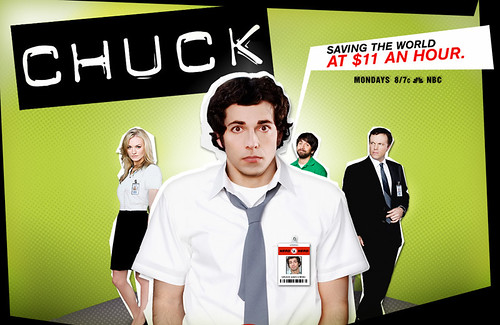
Chuck

I was watching Chuck the other day and our favourite spies dropped in a reference to Microsoft’s cloud storage service – Skydrive. The reference jarred for any number of reasons: first, Skydrive?  Everyone knows Chuck would use Dropbox if given the choice . Second, they’re the CIA – they use a public cloud service? Didn’t they get the memo on the Federal Community Cloud?

Geekiness aside, I think the principle objection I had was one of subtlety; this is one of many clumsy modern references to sponsor products. Chuck also takes a chunk of cash from Subway, resulting in (amongst other people) the massively chubby store manager/assistant store manager, "Big Mike" chowing down on the latest sandwich chain from the fast (or is it fresh?) food chain (odd choice there, guys, after your years of working with Jared). I actually quite like Chuck’s veiled references to Alienware – at least I think that all the computers that Orion left for the family Bartowski were Alienware machines – because they allude to the awesomeness without writing it ‘on the nose’ – as Robert McKee would have otherwise complained (see commandment 9).

I’m probably more forgiving – and more aware – of product placement than most, but the ‘on the nose’ model of product placement always winds me up slightly. Nokia’s presence in the Star Trek reboot  for example – whilst the product wasn’t mentioned, the 23rd Century Nokia ringtone was just annoying. Ditto for the Bond films – every product is shot as lasciviously as they film Daniel Craig’s pectoral muscles.

I think product placement has so much more power when its incidental – and, in the case of the BBC, accidental (the beeb is not allowed to do sponsored product placement, despite the relaxing of that law for commercial TV in the UK). Although, that obviously cuts both ways – when I noticed Evil Janine from Eastenders using an Android phone last night it made me question the goodness of Google (not really, but, y’know)…

That said; if I used the products in question (if had had been Evernote or Dropbox) would I have been more forgiving? That glint of recognition that makes me feel validated in my choice of product or service? Perhaps. But then this isn’t an exercise in customer acquisition, its one of retention…

So my top tips on product placement, from a consumer’s perspective:

  1. Subtlety wins out over blatant plugs
  2. Brand relevance! How exactly do you want to position the product/service
  3. Minimise the cringe factor
  4. Context is vital. If it jars with the characters/plot of the show, fans will resent you instead of admire you
  5. It’s probably more about validating your existing customers and maybe – subliminally (although that’s definitely not allowed) influencing prospective customers – than about wholesale customer acquisition.

What do other people think? Would you be more likely to desire/buy a product if your favourite character on your favourite show was using it? Or would it only work if you already had it?

Is Malaysia becoming a laughing stock in the eyes of the global press? Or a bad joke?

Two news stories that made the International press this week highlight the shifting role of Malaysia – my birth-country – on the global scene. Only a few years ago, it was held up as an example of a reasonably progressive, fast-growing, fast developing Asian economy. Today? It’s increasingly a laughing stock.

First – the ‘obedient wife’ club’, founded by 800 married women in Malaysia in a bid to address the problems of domestic violence and divorce “at their cause”. The foundation of a social group – even one with 800 women in – wouldn’t ordinarily make the headlines in the International media. But the ludicrousness of this particular story must have tickled a few editors’ funny bones, or made some misogynists smile. I find it absurd that Malaysian society could have evoked the creation of such a club, or brainwashed women into thinking that their husband’s infidelity, violence et al, was their own fault. I may have missed something in reading this story – if anyone can explain a positive spin on this to me in terms other than this that would be appreciated.

Second – another leak – this time of a diplomatic cable to Washington:

A former senior government official has said that the country’s bloated and overwhelmingly Malay civil service was “completely loyal to Umno” and was the main stumbling block towards economic reforms according to a leaked United States diplomatic cable The confidential report sent to Washington from the US embassy here was leaked by whistleblower website WikiLeaks and published in the Malaysia Today news portal

This one hasn’t yet been picked up internationally, so perhaps the country is still on the laughing stock side of things…

If I felt any affiliation with the country beyond my family being there, I’d be ashamed. Instead, I just feel moderately contemptuous of the rulers and pessimistic about any positive outcome. After all, it may be droll and amusing today – but its a short leap from droll to impinging freedoms (both in practice in Malaysia and in terms of its international reputation).

Don’t get me wrong, the country’s not at tangibly uncomfortable levels of government corruption, control or oppression… but if it was sliding in a direction, that would be it… Remember the Sarawak story…?

Market forces explained by Emily

My 8-month-old daughter has a really good way of demonstrating market forces, in particular supply and demand.

When there is limited supply (i.e. I don’t have the toy) demand is proportionally great, and I will do anything to obtain the goods required, especially if I think the goods required are being deliberately withheld by an oppressive regime (playful parent) – measures may include clambering over interfering parents, crying and/or grabbing painfully (the baby equivalent of a declaration of war).

When there is a glut of supply (i.e. I have the toy), the demand dwindles (and I can commence one of my routine experiments to verify that gravity is still working by dropping aforementioned toy on the ground, preferably from a height) – the analogue of losing interest in a war on foreign soil.

Am I extending the metaphor too far?

The Doctor’s war poetry

I loved the mid-season finale of Doctor Who. Dramatic, funny, tragic, brilliantly executed and fully entertaining. The thing that I thought was particularly well done was the poem

Demons run when a good man goes to war.
Night will fall and drown the sun, when a good man goes to war.
Friendship dies and true love lies, night will fall and the dark will rise…when a good man goes to war.

Brilliant meter, wonderful classic war poetry style and scansion, and brilliantly recited by Alex Kingston. I can’t work out if it was original for the show – it seems to be. Check it out yourself here (may not stay long, but the BBC replay link is available above):

HBO’s Game of Thrones–first impressions

GAME-OF-THRONES-HBO-3

We watched the opening episode of HBO’s new fantasy drama series last night – Game of Thrones. It’s been showing for some weeks on Sky Atlantic / in the US after months of filming in Ireland and lots of hype on both sides of the pond.

It’s based on George R R Martin’s epic Song of Ice and Fire epic fantasy series, the first four books of which I blitzed through last year. Rich, immersive, politically complex, multi-faceted plotlines with an enormous cast of players. I wondered how it could make the transition to the screen and, having seen the first episode, I’m totally sold.

Atmospherically lush (that is the right word) you’re immediately sucked into the world and the politics of the Seven Kingdoms. The casting seems fairly spot-on at the moment – especially Tyrion Lannister – and Sean Bean is appropriately gloomy as Lord Eddard of Winterfell.

As you’d expect given the format, it whips its way through epic fantasy at quite a pace. Given that Mr Martin has taken some years to pen the fifth novel in the series, I do wonder how the pressures of commercial television will come to play in driving the completion of the series. In fact, Mr Martin has taken such a long time to get the next novel out that there has been some furore from the fans – evoking this perspective from fellow fantasist Neil Gaiman (in short, George R R Martin is not your bitch). He is, however, in some sense, probably at the beck and call of the nice people at HBO, which has picked up the show for a second season…

Trailer here for the epically curious:

The Apprentice

Lord Alan Sugar at Destination Growth '09 So prior to the current series, I’d never watched the Apprentice. The concept reminded me too much of some curious hybrid of actually working and interviewing for a new job through one of those awful milk-round processes where you have to do ludicrous, unrealistic exercises to prove your worth.

Amanda brought me round. As with football and celebrity, and occasionally Eastenders, The Apprentice has become one of those shared frames of popular reference. Everyone has a view on it; everyone gets caught up in the exercises, and for those of us who work in marketing… there’s a thousand lessons of what not to do painted every week.

This week, I have a new phrase for an undifferentiated marketing proposition. The "Every Dog." If anyone tries to pitch me a generic sounding service again, I’m just going to say "No thanks, that’s too every dog." It might even work.

Talking to a colleague today gave me an insight as to why there’s such a strong appeal to the programme. They do seem to find curious, dysfunctional groups of people to collaborate on these projects. The net result is dramatic, exciting, and ludicrous television, in which modestly intelligent people get on so badly that they fail, in many cases, to organise the proverbial piss up in a brewery. Which makes you feel good about your own merits, modest as they may be.

Lord Sugar; thank you for this feel-good television. It’s the best thing I’ve got from you since my Amstrad PC 2286.

Macifying Windows

Mac sous Windows Seven : Soirée présentation Windows Seven{sigh}. Despite promising myself never to go over too far to the dark side, there are some aspects of OSX I’m loving and missing very much on the Windows machines I use. Some things I definitely am not happy about (the lack of a proper blogging client, for one), but here’s a few things I’ve twisted Windows into doing (or tried to) to mimic the capabilities of my Macbook. There was a recent Lifehacker post that inspired this one…

  1. Switcher / Expose clone. Much more practical than ALT-TAB, simple, small third party app.
  2. Two finger scrolling. The simple app doesn’t work on 64bit Windows 7 but I’m trying to mess around with this Synaptics touchpad hack – apparently despite the fact that most new PC touchpads are capable of multitouch gestures they are frequently locked out of using them!

Things I’d like to bring over….

  1. App store. I have to go through a manual FIlehippo trawl to keep my PC software up to date.
  2. Pinch to zoom etc., (which, infuriatingly, doesn’t work with Microsoft Mac applications)
  3. Sparrow!!! One of the most popular search terms on this blog is “Sparrow for Windows” so I know I’m not the only one. C’mon you guys!
  4. The instant sleep / wake and long battery life of OSX, and near instant boot time on the SSD

Things I’m not a fan of:

  1. Network settings on OSX. Feels too fiddly, locked down.
  2. New shortcuts. I’m starting to muddle Windows and Mac shortcuts, forgetting which is which
  3. Lack of decent, affordable blogging clients
  4. Resizing windows from any side. We had to wait through 7 iterations of OSX for that?

If you could create the bastard love child of Windows and OSX, what would you put in it?

Armand David's personal weblog: dadhood, technology, running, media, food, stuff and nonsense.