
Innocent smoothie sugar content – not so innocent?

Innocent Smoothie!!Damian was round the other day, and with his tired hat on (as much as his business journalist hat) he was commenting on the sugar content of an Innocent smoothie. He referred to it as a great ‘sugar hit’ — which didn’t feel right to me, not when compared with the sugary soft drinks I’ve made a cursory study of. After all, there’s a heckuva lot of sugar in a can of coke.

So I looked into it.

By my estimations – natural sugars or otherwise – there is the equivalent of a can of coke’s sugar in the same volume of strawberry and banana smoothie – around 8 teaspoons. Of course the smoothie bottle is marginally smaller than a coke can – but it’s still pretty high! Innocent describes this as:

The amount of sugars in a 250ml serving of our smoothies averages at 29g or a third of your daily requirement. Or, put more simply, the same amount of sugars that you’d find in a banana and another portion of fruit (which makes sense, as smoothies are two of your 5-a-day portions).

Which makes it sound much better, but this is one of those things we in the trade call ‘positioning’. Not sure it helps that much here, or if there’s anything they can do about it given that they pulp fruit straight into the bottle (apparently).

So chalk this one up to one of those occasions when Damo is bang on about something, and take a care when next you hit up Innocent for a smoothie. Those things are sugar-tastic, and probably not great for diabetics.
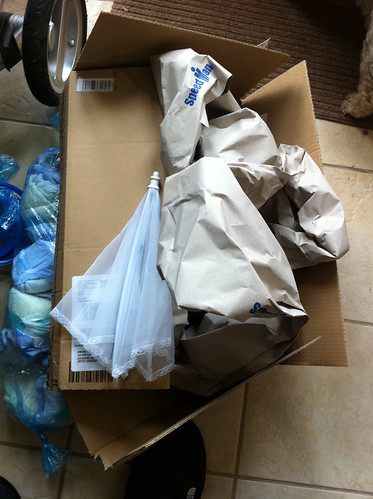
Amazon packaging – the environment is overrated

Amazon packaging with tiny productStraight up – let me tell you – I love Amazon Prime. I’ve been a customer for years and the convenience that £50 a year or so gives you is phenomenal – next day delivery on EVERYTHING they sell themselves. Amazing.

And often I’ve been impressed at the ‘limited wrapping’ options available on some products – where they’ll tape a USB key to the inside of an envelope or something before they post it to you. Great stuff there, guys.

But something went wrong this weekend. I ordered a ‘food umbrella’ – one of those things you put over the fruit bowl when the weather gets warmer to keep the flies out. At £2.25, it was not an expensive purchase, and as a folded up piece of lace doily, essentially, it wasn’t heavy or bulky.

So I was a little surprised at the box (pictured). Not sure what in Amazon’s P&P system went wrong there but  we were couriered a box that you could probably have squeezed about 100 of the umbrellas into – in which sat a single, solitary, lonely food umbrella.

D’oh! I’m suddenly curious as to whether this was an automated error or if someone actually went to the time and trouble to package that in there. I think I’ll ask Amazon UK on Twitter and will keep you posted! I’ve also submitted the picture via Amazon’s packaging feedback website – hopefully help make the service that little bit better!

A week with the HTC Sensation

HTC Sensation: A1 bringt erstes Dual Core Smartphone von HTC =A week after giving up on the the Blackberry Torch as a clunky not-quite-there-phone, my brother-in-law has given up on the dual-core Android 2.3 megadevice, the HTC Sensation. He much preferred it to the Torch, but, as I suspected it might, the iPhone has ruined him for even marginally less intuitive mobile devices, and the freedom of choice on how to customise the platform was more than he wanted. His thoughts below; which chime neatly with my own thoughts on the Android platform. Powerful, but not ready yet.

Bil’s review:

So, the htc phone…. Well, perhaps the reason I’m writing this note on the iPhone probably says it all……!

Sure the bigger screen, amazing camera & great graphics will win you over, plus the speaker phone is also strong but as an everyday practical device there are still too many minor flaws. Writing a simple note, a reminder, a calendar entry all involve too much ‘faff’. It’s just slightly tedious, your thumb precision is really tested (ok, sure you can rotate the phone for a wider grasp but that requires readjustment and hassle). Perhaps the htc is overengineered? Flexible gingerbread platforms and custom home pages allow you to create and personalise the phone to fit your preference. Fine. But then what?? If it doesn’t do what you want it to do what good is a sexy layout?

iPhone 5 or whatever it’s going to be labelled, will bring something new to the Market…. again, so i’ve decided go reacquaint myself with the iPhone platform ahead of what’s round the corner.

So, here’s to Apple and their product, it’s good in all areas rather than being spectacular in some and letting itself down in others…..

Sent from my APPLE mobile device

Baby social media management services

Chris (and Tom and Damian) came to visit this weekend, and as is inevitable when {heavy irony} social media gurus {/heavy irony} come together, we brainstormed new business concepts.

Well, maybe not entirely new, but ‘Baby Social Media Management’ seemed a concept worth exploring, so we checked if http://emi.ly was available (it wasn’t, already registered to some doting Bavarian dad, apparently) and considered other stratagems for maximising my 7-month-old daughter’s social graph. Knowem seems particularly well named for my daughter’s use…

As part of this discussion, Chris pointed me at this case study – which, needless to say, is dynamic, interactive, synergistic, integrated social media success.

Pink pony integrated marketing campaign ftw

Should I buy an iPad 2 for my commute?

This isn’t something I’m considering, needless to say, but a question I was asked by an old friend, who predominantly uses Google Apps to run his own business. The short answer is – no if you plan to work on your commute, yes if you plan to play. This is what I told him in more detail:

I have an iPad and I do like it, but I recently switched to a Macbook Air for working on the train (plus 3G card). It’s not the most elegant solution but there’s a few reasons why it made sense for me.

1) Any substantial typing on the iPad is mediocre at best. It’s accurate as you could hope for a touchscreen but you just get tired tapping into a smallish screen if you use a full-size keyboard the rest of the time. You can fix this with a (pricey) keyboard accessory, but this diminishes the elegance and portability of the iPad.

2) File conversion and ‘offline access’ to documents is patchy on Google Docs (not sure there’s an easy way to make it work), and conversion of other people’s docs (Spreadsheets and PPT especially) is generally awful. Depends on the app you use, but there it is.

And why the Macbook is better, although still not perfect.

1) Offline access – quick to get started with offline apps for drafting stuff if 3G is patchy – I use Evernote as well as the more traditional offline productivity tools to draft stuff

2) Full keyboard!

3) Good battery life

Cons

1) No built-in sim card slot

2) Expensive

3) Slightly more clunky (although an 11" Macbook air is still pretty sleek)

Overall, though, if you’re using Google Apps bear in mind that Apple and Google are at slight ideological odds – the native iPhone and iPad apps from Google are rarely as good as they are on their Android equivalents. Although there is a Mac Gmail client – Sparrow – that is a thing of awesome beauty and power.

I love the iPad as a media machine – books, TV, etc., – but the Macbook is my true workhorse these days. Well, my personal workhorse – still all PC at the office.

Have you read about Chromebooks? If you’re running Google Apps they might be a better bet for you, I’m not sure.

The supermarket lottery of life

OcadoWe’re trying a different online grocery service – Ocado. After years of using Tesco.com and finding that it had by far the best online experience of all the online grocery stores (I’ve tried Sainsbury, Iceland and Ocado in years gone by), a friend who worked for John Lewis’ consistent evangelism and a couple of vouchers, coupled with a persistent desire for us to eat healthy, provided the push we needed to give it a another go. Over the years they have revamped their website and their delivery service is superb – slick and seamless where Tesco’s is clunky and fiddly. One example of this is that they bring the groceries in bags which they collect on their next delivery, ensuring they can walk straight to your kitchen and not faff around with trays or pallets and you’re still empowered to be moderately eco-friendly as far as the bags are concerned. Also one-hour booking slots, etc.

It struck me that online delivery services free you from the supermarket lottery of life. Whilst proximity to good groceries was an important factor in us choosing our home, we weren’t specific about the grocer, and as it happens we’re in a Tesco catchment area – the nearest Waitrose is 15 miles away, Morrisons and Sainsbury’s about twice the distance of the local Tesco. This means you get accustomed to a certain level of mediocrity from your shopping after a while, and you get constrained by the choices Tesco imposes on you. One massive bonus of the village we’re in is we have two local butchers, so at least for meat we have some extra choice… and of course our garden will hopefully soon provide some veg.

That said, the delivery charges on Ocado are steep and we’re not sure yet if we’re going to set up a recurring shop (which gives you free delivery) as there is a certain joy and satisfaction in actually going to a shop and getting inspiration for meals that way. OK, it’s not Rick Stein wandering through the markets of a Mediterranean town, but it’s less sterile than hitting a virtual checkout…

Lactofree yoghurt

Lactofree Fruit YogurtsI wish I was a teenage American girl so I could say “OMG this stuff is the bomb” or even a teenage Welsh girl so I could say “this stuff is lush.*” Because after years of having to eat soy or ‘healthy’ yoghurt to counteract the impact of creaminess on my lactose-intolerant self, the guys at Arla have created a lactose-free yoghurt creation that is absolutely delicious. Highly recommended.


* is this how the kids are talking these days? I’m getting old.

The hidden cost of inflation

I was talking to @geowgeow about why things cost random prices in shops, on seeing a surprisingly reassuring price-list in a sandwich shop in Victoria station. Everything there cost rounded whole numbers instead of apparently arbitrary digits – 12.64 is a pin code, not a price tag dammit!

Carrying the thought through (as you do) however led us to the fallacy of this – inflation is running at over 4%, so a 1 pound sausage roll would have to cost 1.04 next year and so on. So the silly prices return.

@geowgeow speculated that rounding for tidiness is probably worsening inflation – store managers that don’t like price tags that say 1.04 round up to 1.05 and BANG – up goes inflation by another percentage point.

Alan Sugar might be happy with the entrepreneurial instincts shown here, but Mervyn King? He’s probably unimpressed by the entire situation.

Metro front pages–tech is so mainstream

I love technology as much as the next man – my wife would say considerably more than the next man – but I’ve still been moderately baffled by the editorial decisions that planted not one, but two tech stories on the front page of Metro in recent weeks.

First – the Twitpic story (which seems to have been taken off the Metro website but is still visible in the search). In brief: Twitpic changed its terms of service so that it owned the rights to the pictures its users uploaded. Twitpic is a photo service built to work with Twitter. During the course of the day, as Chris charted so well, Twitpic redacted its changes and reverted to the original ToS. All sorts of bits have since emerged, including a letter Tom received from the Twitpic founders stating that the rights to all photos would be available through a specific photo agency (now gone from Twitpic?). So I totally agree there’s an interesting story here. BUT… front page? Twitter is a service used by a growing minority, but still a minority (I don’t believe the stories that say it has hit the mainstream in any meaningful way)… and Twitpic is used by a subset of those users. Doesn’t strike me as front page news by any stretch of the imagination. Still, let’s call it a slow news day.

Second: The dramatic front page: “Android phones ‘all leak secrets'” – later retconned/subedited on the web to “Android phones almost all vulnerable to hackers“  – I mean whoah. That’s one heck of a front page. PC Pro blogs explaining why people shouldn’t be concerned (I actually think PC Pro’s view of a world where people know they should not connect to an unsecured wifi network is more than a little naive) – but seriously, this is a) a story that affects a relatively small number of people (despite Android’s increasing user base) and b) in no way front page news. Seriously! If, every time Microsoft patched a flaw on Windows (and there have been more serious and more easily exploited vulnerabilities discovered on Windows XP, I’m sure of it) –> well then, we’d have a front page a month that would at least fit the criterion of relevance to the readership, if not one of the slightest bit of interest.

That said: the superinjunctions story (yeah, that one) did bring Twitter to the focus for the whole country, so those front pages – totally make sense. No confusion there.

On the whole, however, a little confused as to what the Metro editor was thinking here, and would love to know if its a tech agenda, a sense that it’s sexy to pick on web 2.0 companies in a Daily-Mail-sort-of-way, or if that really is how they see their readership; Smartphone wielding, picture sharing, Daily-Mail reading digital natives. Which, looking at the history of front pages on Metro that come up in Google images, might make sense: they feature evem more tech stories including £3 Amazon MP3 albums, “Planet Facebook” and an Android scare story from earlier this year.

Damn, tech is so mainstream.

Internet killed the traditional book store. And the record shop. And the…

There’s a lot of talk amongst our client base of the new business models and innovation possible thanks to the power of the Internet. There’s also a signficant amount of chat about what it means for the pre-web business models – particularly in the media sector.

Look at Waterstone’s, sold last week for a relative pittance. And the share price of the HMV Group – on a persistent downward spiral over the last 12 months – demonstrates how poorly that business has adapted to the Internet age. Contrast that with Amazon or even B&N and you’ll see that real innovation is needed to translate some of those legacy business models to the new delivery platforms we have for media. Amazon is selling more Kindle books than print books – absolutely astonishing. Who would have guessed that things would move this quickly?

B&N, worth around $1bn, as Tom pointed out on Twitter the other day, has managed maintain its valuation where Waterstones et al haven’t. The analysis points out that it has tried to keep on the edge of things with an innovative eBook portfolio in the US. Tom sums it up neatly:

If that’s not an advert for why old media businesses have to aggressively investing in digital platforms, I don’t know what is.

Waterstones’ e-commerce ventures were hopelessly bumbling – first a partnership with Amazon, then its own webstore, and then perhaps a slightly misjudged ebook strategy which I still don’t fully understand today.

I guess, though – that at least they tried. And establishing what insights are needed to drive appropriate customer-centric innovation requires an understanding of customers that goes beyond what they themselves think they need – three years ago when I first got an e-reader, virtually no-one I spoke to was willing to give up the feel of a rustling paperback. We would never have guessed that so many people would be reading everything on Kindle [apps] this soon – but here we are.

The worse thing anyone can do about the Internet is bury your head in the stand. It’s a rolling force for change, whether we like it or not, and is having a dramatic impact on virtually every business I come across – nowhere more dramatically than in the media sector.

My brother talked about the need for smart, digital people in the film and TV industry over on Screen Daily and the apparent dearth of them in his industry. As someone passionate about the media sector here’s hoping that the digital people find their way out of the woodwork and help with the industry in the evolution of its more traditional business models… so there’s not only aggressive investment, but sensible investment in the development of new business models…