The Heroes – Joe Abercrombie

I absolutely blitzed my way through Joe’s First Law trilogy, and made relatively short work of ‘Best Served Cold‘  – the first sequel, set across the sea in the same universe. But I’ve been very slow at getting through The Heroes, another follow up featuring many of the characters from the original trilogy.

Normally, compulsive commute blogging and the return to work notwithstanding, I’d have made more progress here – I read very quickly and yet I’ve taken the best part of three weeks to get two thirds of the way through this one. But I think its the slightly experimental narrative style that’s slowing me down.

Unlike the first four books, which covered a relatively long expanse of time and events, the first four hundred pages of Heroes takes place over the course of three days. You might think this makes for a ludicrously high words to event ratio, but instead what it makes for is a large and detailed tableau of a battle, in which we’re provided insight into characters’ inner monologues, doubts and fears; into military strategy, manipulations and intrigues; into insults, wholesale slaughter and semi-wise philosophy. One scene / chapter will take the point of view of three different characters, one of which might end up dead three paragraphs later before passing the torch to another. It reminds me of the Scrubs episodes when the internal monologue was passed to a character other than Zach Braff – a jarring experience on television, it’s even more bizarre in a novel.

For many this might well be the perfect fantasy novel fodder. For me? I like the larger story arcs – the epic quest, the conflict between good and evil that sits at the heart of this. The character in the novel – Bayaz – that is the driving force for one side of the conflict – is himself contemptuous of the detail of the battle. It’s hard for me to be enthralled…

But as the battle progresses and the pre-ambles complete, the novel is picking up its pace. I imagine I’ll be done by the weekend and looking to add the next Joe Abercrombie to my reading list… His dark, cynical view of the world – tempered by the doubts of his heroes – makes for stories that are quite different from your run-of-the-mill epic quest.

Next up? Trudi Canavan’s newest Black Magician book. Then? I might eventually finish the novel in the Last Chronicles of Thomas Covenant I keep failing to pick up… followed by Eoin Colfer’s take on the Hitchhiker’s guide universe (how did I miss that had been written?), before I wait for the newest book in the Stormlight Archive, Charlie Stross’ Rule 34 and Terry Pratchett’s Snuff to be published – not to mention the latest George R R Martin.

It’s nice to have a few books to look forward to.

Army of Darkness defense – iPhone game review

Army of Darkness Defense Review for iPhone and iPod Touch

I used to spend a lot more time gaming than I do these days – the slightly dormant PS3, Xbox and Wii attest to that. But the iPhone has proved a good platform for the occasional gaming fix.

The newest addition to my games library is Backflip Studios‘ 59p game – Army of Darkness Defense. Based on the 1992 Sam Raimi film Evil Dead 3: Army of Darkness – it sees Bruce Campbell‘s character face off against an army of ‘Deadities’ – undead warriors from the film – in a side-scrolling tower-defense game.

Huge fun. Original voices, clever upgrades to weapons and units, decent graphics for the gameplay style and compelling enough that you’ll be able to resist most of the in-game purchases – coins for upgrades – and instead just play the game obsessive compulsively until you clear wave 50 of the Deadites. There’s some slowdown when the waves get big – bring on the dual core iPhone 5 – but it’s not too bad.

My only significant criticism of the game? Only 50 waves… I’m hoping that a software patch will add a bit more variety to it.

Charismatic train guards

Usually, the train guards on Southwest trains are fairly unsympathetic. They’ll barge their way through a massively overcrowded train asking to see people’s tickets, trampling on old ladies and kicking children in the stomach in the process.*

Today, in an inspired moment, our guard told off the people who had left bags on the seats. “No matter how many times I tell you all, some people still left bags on the seats despite the fact there were people standing. I don’t want to see any bags on the seats when I walk through the train!”

Genius. Sometimes I think the larger the crowd of people the more the authority figures need to treat them like itinerant children… at the very least, it makes for a few guilty looks and a selection of wry smiles…!


*not quite, but… y’know.

Simple language is best

I ran a training session just before I went on sabbatical on various social media bits and pieces, showing people how to use search engines to find key phrases – amongst many other things.

Over the course of the session, which I tried to keep jargon free, I somehow managed to tell people that they should "concatenate their search terms" and use "Boolean search." I was also talking about influence and sentiment analysis, so there was a lot of jargon floating around that I couldn’t seem to avoid.

I think us social media-y types (oh, god, is that what I am?) should have our own translation engines, like the Bank of England. Check it out :

Inflation is likely to pick up to between 4% and 5% in the near term, and to remain well above the 2% target throughout 2011, boosted by the increase in VAT, higher energy and import prices, and some rebuilding of companies’ margins.

Which means:

You will continue to be squeezed in the next couple of months by the government, overseas governments and companies.

Otherwise we might as well just be doing this.

(As an aside – I love that the CItyWire piece, in addition to clever writing, included a bit of clever coding. That principle – of creative storytelling in new ways, whether through interpretation or presentation of information and analysis – is one of the key things that will keep people passionate about traditional media venues, IMHO).

Herman the cake

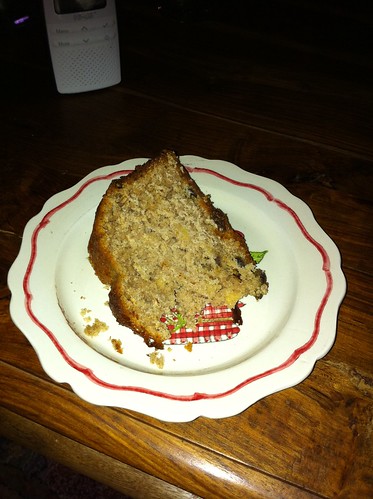
Herman I’ve never been a fan of chain mail… until my wife got this one from a friend in the village.

Using a sourdough starter, a set of instructions guided Amanda through the process of making a very tasty sourdough fruitcake. And given that Herman is based on a ‘live’ mix, it is designed to be expanded and shared. It was, however, as you’ll see from the recipe, a considerable amount of work for Amanda, so she was a little reticent about spreading its offspring…

It however, was delicious, and is a crazy way of spreading baked goodness amongst your friends, if you happen to know some passionate bakers… According to Lucy it’s good with apple and cinammon and a thing to be expected in the Home Counties.

I’m wondering if my baking colleague at caketakesthebiscuit has experienced this one…

Quora for research

I’ve been checking out how useful Quora is to new business research recently and it really is a wonderful network for getting under the skin of a company. You find questions from marketers, strategists, analysts, customers and beyond, answers from the same and from the companies themselves.

I’m a bit of a leech on this social network  – as with Twitter I find it hard to stay close enough to the topics I’m interested in or qualified to respond to to contribute meaningfully. But many good questions have been asked and answered (even one of mine). Definitely recommended – don’t think Facebook has manage to build the same cult of users for this particular service of theirs as yet, and its unlikely to be useful for professional insight (for me, anyway) just yet.

British names for American ingredients (and American names for British ingredients) – a 101 guide (basic tutorial)

(Warning: the following video contains some classic Izzard swearing and might therefore be NSFW. It however perfectly sets the scene for this post, so watch it anyway).

I read a lot of American food blogs – as you may have gathered from my Kenji tribute. But one of the things that grates slightly is the fact that we have slightly different vocabularies for a number of common (and some not-so-common) cooking ingredients. I asked my friends on Twitter and Facebook to help me come up with some key points of contention and here’s what everyone came up with…

  • American – British
  • Cilantro – coriander
  • Rutabaga – swede – wtf???
  • ‘erbs – herbs
  • frosting – icing
  • Zucchini – courgette
  • Maize – corn
  • Eggplant – aubergine
  • Soda – soft drinks
  • Tomayto – tomato
  • Chips – crisps
  • Fries – chips
  • Jelly – jam
  • Jello – jelly
  • Baysil – basil
  • Arugala – rocket (seriously wtf?)
  • Scallions – spring onions
  • Baking soda – baking powder

Contentious

  • Noodles – Pasta (I thought they just called it paaaasta)
  • Entree – main course (Isn’t this a French thing?)
  • Corned beef – salt beef (I thought American corned beef was tinned, processed beef hash)

Can anyone clarify?

and also…

  • Budweiser – beer (not sure these are synonymous)
  • Potato – potato
  • American cheese – wtf? (via @qwghlm, I actually think there’s a time and a place for American cheese)

Thanks to friends on Facebook – Farrah, Mary, Kate, Caroline, Lucy, James, Graham and on Twitter – qwghlm, AndreLabadie, jogblog and gateauchateau for the suggestions.

Any more for any more? I think we have the Spanish influence to thank for some of these (cilantro I think is Spanish for coriander, for example) but absolutely no idea where some of the others come from and my curiousity doesn’t extend far enough to investigate.

It’s amazing how much difference a few short centuries can make to linguistic divergence. In another few months, we probably won’t understand anything the Americans say!

In a side note, that’s the single most successful crowdsourcing request I’ve ever made. I guess you have to ask the right questions for your network!

On the greatness of Kenji Alt-Lopez, food blogger supremo

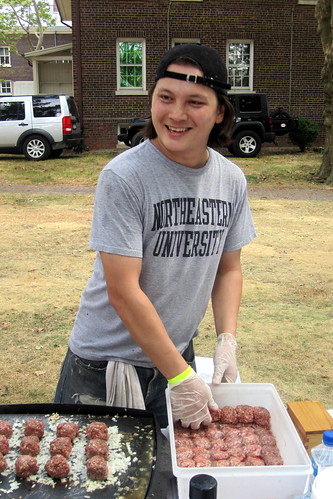
NYC: Meatopia - J. Kenji Lopez-Alt Kenji’s posts on all things food continue to be nothing less than inspired. I still use some of his tips for making the perfect french fries for my roast potatoes (add vinegar to let you par-boil for longer without losing structural integrity), his posts on pizza, burgers and general knife and other skills inform an increasing number of aspects of my cooking. Let this post serve as the beginnings of a tribute.

The posts that inspired this one were two fold; first, Kenji’s efforts at improving the Big Mac – genius! The scientific method here – rather than the letter of the process that our friends Messrs Blumenthal and Myrhvold espouse, provides a wonderful, iterative, Macgyvery feel to the way he reverse engineers a food classic.

Secondly – Pizzagna. So wrong, and yet so right. Almost something that should appear on Epic Meal Time – but because it comes from Kenji I actually kind of want to eat it.

Be assured, however, the majority of his posts are on more everyday helpful things, including avocado knife skills and general basic cooking principles, so he’s a resource for the world, not just fast food aficionados.

Anyway, if you’re interested in food you should follow Kenji’s work across the Serious Eats blogs. Despite the moderately US-centric nature of it, a lot of the content is fascinating and useful wherever you are – and he seems a pretty global-outlook-kind-of-guy, so there’s some International content too.

Coming soon: a dictionary to help interpret American food names for Brits. And vice-versa.

Crowdsourced and 100% delicious.