Tag Archives: Technology

TranquilPC – good service or bad?

Whilst I’ve been frustrated with how long its taken Tranquil PC to fix my media centre, I finally got an explanation out of them on Friday; they’re not only replacing the hard drive but upgrading the whole build to the latest components needed to ensure repeat failure doesn’t happen. I’m guessing something overheated as the parts being replaced include the cooling system and the DC power supply unit.

I’m not sure if I should be annoyed at being shipped a ‘defective’ machine or impressed that they are taking the trouble to use what they’ve learned in the last 9 months of shipping my PC to upgrade it for me. I’m leaning to the latter; but we’ll see what kind of shape its in when they eventually get it back to me…

Blackberry continues to do well in business because it is a terrible phone

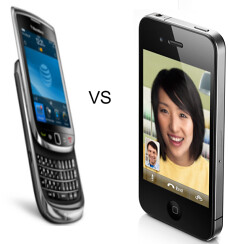
BlackBerry vs iPhoneRIM/Blackberry’s days are numbered, IMHO. As a mobile platform, it is lagging painfully behind its rivals and increasingly only die-hard fans, luddites and bankers remain loyal – and the latter generally have little choice.

There are a few reasons it succeeds in the enterprise; its excellent push-email platform and its high level of security. However, one reason why it does well is because it’s a terrible, terrible phone.

Say what?

Well, as anyone that’s ever looked into it will know, managing a business contract with a mobile operator comes with its moments of extreme tedium. One of these is dealing with the monthly billing – where people with disproportionately high monthly bills need to account for their calling patterns, going through a gargantuan itemised list of calls, expensing some and paying for others. Few of the mobile operators are doing such fantastic deals on inclusive minutes at an enterprise level that businesses can afford to ignore high levels of usage by even a small proportion of the user base.

This is one of the reasons why some businesses will hesitate on the iPhone. People will be more likely to use it as a primary device, giving up their personal mobile, and this will drive billing and administration costs up. There’s already a higher initial cost and this would be compounded. Blackberries are so hopelessly clumsy for anything but email they tend to be used as a back-up phone if at all, so this problem is far less significant.

And businesses can’t just subsidise individual mobile tariffs. For my employer to contribute to a mobile tariff I pay personally would constitute a “benefit in kind”, they would have to give it to me gross of tax – so probably a 30-40% premium on the mobile tariff. Which doesn’t make any sense at all.

So – mobile operators, if you want to make the premium on iPhones by selling them to business (as Apple seems to want you to), then launch some more affordable ‘all you can eat’ or flexi tariffs that will cope with rogue users. And RIM? I have no advice for you. I’ve no idea who will acquire you when your fortunes flounder for the last time, but can’t help but think that’s where things are headed…

Lion upgrade

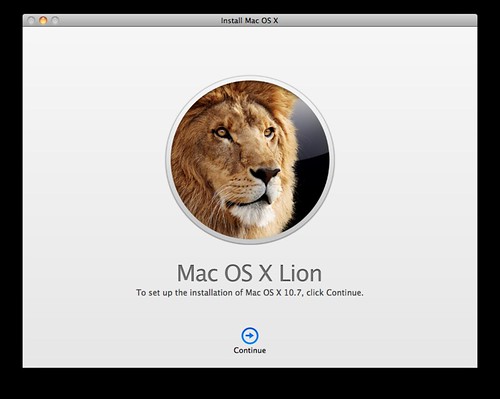
Lion InstallerI upgraded the Macbook Air to OSX Lion this morning. Not much to say yet; it took a long time to download the 3.49GB upgrade, but it installed in 30 minutes during the course of which I had to unplug the Macbook – I would never dare do this on a Windows machine, but it worked fine here.

The first thing I did was disable the new reverse touchpad scrolling thing – that is, what Apple did to bring OSX in line with iOS from a scroll usability perspective. To me, it was just counterintuitive – I am sufficiently used to computers (as opposed to tablets) that I don’t find it unnatural to switch between gesture modes.

I do have some other new touchpad gestures to learn, and it generally seems shiny. Will post further impressions if I notice anything significantly different in the days ahead.

I’m trying not to be upset that they upgraded the Macbook Air I just got four months ago.

Media centre saga continues

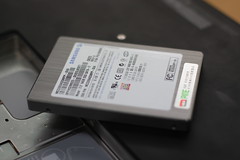
SAMSUNG SSDAfter much chasing, the saga of my media centre PC continues. SSD failure. Who thought that happened, ever? Well… I know it happens, theoretically. I just never thought it’d happen to me. Wonderful as these devices are I guess they’re not necessarily as durable as I thought, despite the lack of moving parts.

I have been distinctly unimpressed by Tranquil PC’s response times; despite promising to return the machine within 10 working days, they’ve had it for the best part of three weeks and I’ve had to write to the company MD to get an update on where it is. I know how long it takes to swap out a drive… so not sure what they’re doing with it.

The failure is going to prompt me to accelerate my "personal cloud" strategy and choose one of the cloud providers out there to mirror my filing system. Dropbox is too expensive for the volume of data I have (50GB music, 40GB pictures, 2GB docs etc), but given that most of that data lived on the secondary SATA drive (which I’m hoping is intact) – with luck I won’t have lost anything too substantial.

What I will invariably have to do is go through the unique displeasure of reconfiguring a Windows install from scratch, including setting up the fiddly and frustrating Windows Media Centre software to receive HD, something that took a not insignificant amount of fiddly hackery to begin with. Google Chrome being the hub of a lot of what I do, and the fact it syncs stuff, will make it marginally easier, but there are other bits and pieces that need sorting too.

Widi–tastic

Intel WiDi Wireless Display LogoI missed the release of a whole new acronym  – Widi – which is, broadly speaking, wireless display technology that will see PCs hook up with displays (that have special network adapters connected to them) without the need for any sort of cabling.

This sort of thing has been tried before but thanks to the fact that Intel is backing this particular standard it likely stands a chance where it hasn’t before. Huzzah – anyone with any IT skill who works in an office knows that helping people hook up a laptop to an external display – trivial though it is in theory – is inevitably a cause for some tedium.

iPhones for Enterprise

appstorevol

I was talking to a friend about Smartphones in the enterprise. He works for a large public company with a strong heritage of working in the public sector, and therefore an understandably high level of concern about IT security. It was for this reason that – despite the mediocrity of the Blackberry platform against contemporary competition and the plunging market share of RIM – he wanted his organization to standardize on Blackberry.

However, for many people accustomed to more… sophisticated Smartphone platforms, Blackberry seems arcane, counter-intuitive and sometimes an actual hindrance to productivity.  That’s not to say that iPhone, with its Apps, games, ease of use et al won’t cause its own distractions but at least people will be able to effectively browse the web!

So it’s with some satisfaction that I note that Apple is upping the game for its enterprise offer – there’s already Exchange controls on iOS devices (pins enforced etc) and remote wipes and remote management is possible (as is location tracking, natch), so enterprise deployment of Apps is an obvious next step in supporting group policy on App deployments within an enterprise environment. That this holds for non-Appstore apps as well is truly remarkable and a very grown up (and atypical) way for Apple to be dealing with the situation. Now, if Apple could just sort out offline email…

I’m going to write further on why Blackberry’s days in the enterprise are numbered and some thoughts on what mobile operators need to do to create more compelling tariffs for the enterprise for iPhone, as have a few other thoughts bubbling under on this.

Acer Iconia two screened laptop

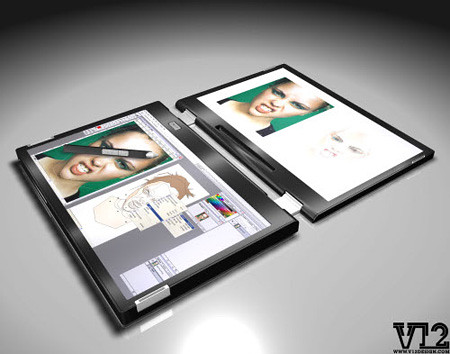
Dual touch ScreenI had a go on an Acer Iconia twin screened laptop whilst ambling through an HMV the other day, and it inspired me to make this comment – this should be in contention for one of the worst pieces of computer design ever. Admittedly I played with it for all of three minutes so take my comments with a pinch of salt, but, in brief: it’s just terrible.

It’s not that there’s anything inherently wrong with the stylings or construction of the device itself – it looked and felt sturdy. But a screen as an input device and a second screen as a screen? What were they thinking?

Here’s a few reasons why this concept will suck totally for a while.

  1. Battery life must be terrible. Laptopmag worked it out at around 2.5 hours but I’m dubious – given that my 7 hour rated Macbook Air gets 3.5 hours the way I use it I can’t see anything like this working for anyone for any period of time.
  2. It’s big, heavy and too bulky for any normal work surface, at home or in the office – unless maybe you’re a designer.
  3. The form factor and the OS make no sense. I’ve commented before about Windows 7 and touch – not there yet. But even if it did (as Windows 8 looks to do), what, would you occasionally hold this thing like a giant book? Stretch it flat and look at it sideways? What? Why? How?

It’s too expensive a novelty. People, if you’re trying to beat out Apple the iPad you’ve got to try harder and come up with better ideas than expensive novelty props.

iPhone app to find nearest pool table #apprequest

moment of impact

I was wandering Islington two weekends ago trying to find somewhere to play pool after discovering that the Elbow Room there has closed down, and despite the abundance of useful data on sites like Beerintheevening.com, no-one seems to have mashed up an app that tells you where the nearest pool table is. C’mon, devs and/or marketing folk for beer companies – that’s a free idea for you. Build it, give it away, and people will use it and buy your beer.

I promise.

Booz & co report on Generation C

booznco

My colleague Harriet pointed me to this interesting bit of futurism from Booz & Co, looking at the rise of ‘Generation C’ – a new wave of digital natives born post 1990.

I used to absolutely love this future gazing stuff but I think I’m getting a bit cynical in my old age. As accurately as this seems to anticipate the arrival of certain technologies in the next 5-10 years, it is predictably Western-centric in its anticipation of tech adoption, and worse – it carries a strong weighting to what ABC1 families will be able to afford and educate their children in a way that they will be able or likely to embrace these technologies.

Charlie Stross notes when contemplating near future sci-fi that the future is, to all intents and purposes – 99% now. Some of the things we imagine as fantastical and futuristic today exists in a lab or in the homes of the ultra-wealthy. I remember reading about Bill Gates’ personalised, automated home 15 years ago – and today there still aren’t mass-market home-automation products of that ilk!

This is the fallacy that Booz & Co have fallen into, IMHO. These technologies will be there, but we’re facing an extended period of economic austerity today. That will mean some R&D budgets get cut and some product launches will be delayed. Look at LTE – for the last three years it was coming in 2011/12, and now some people are saying 2013/4. And who will pay the premium?

My fundamental issue is that between infrastructural challenges caused by austerity programmes and corporate conservatism, the growing divide between rich and poor amplified by growing inflation and increased taxation of the middle classes, we may actually see ‘Generation C’ as even more educationally fragmented than the preceding generation. There may be a high level of general tech literacy but as for more sophisticated use? That calls for more exposure, more support, more education. Not things we’re necessarily likely to see in an environment of increasing university fees, pinched spending in schools and high rates of inflation potentially limiting consumer spending on new technologies.

I interview grads every now and then and the most recent lot were born in the late 80s and early 90s. I find them to be as hit and miss as the grads of my generation, and every subsequent generation. Some had the good fortunate to be exposed to tech and embrace it, most people’s digital literacy starts and ends with Facebook.

But as I said, perhaps I’m turning into a cynical old man.

The rise of (Don’t) DIY PCs

h2452I’m so used to being able to fix my own computer problems it was a bit of a surprise when the – expensive – media centre PC my parents bought me for my 30th collapsed a week or so ago. Out of nowhere, it failed to boot.

The independent PC manufacturer I bought it from was unfailing in its efforts to help me troubleshoot. I was given instructions on how to remove the (clever heat-sink shaped) casing and check the cables (all fine). I ran BIOS checks myself (insofar as was possible). But there was nothing to be done – my primary hard drive had ‘vanished’ along, taking with it my Windows installation.

So it’s been shipped back to home base for maintenance. The cost of shipping, £25, is substantially less than the cost of even a small SSD of the same quality that I’d had in there, never mind the time required to rebuild the machine… but its still frustrating not to have been able to sort it myself. It’s one of the reasons I resisted Mac for all these years – I wouldn’t trust myself to take an Apple machine apart – but to its credit, at least Apple doesn’t have its sole support location in Manchester…