All posts by Armand

Chris Anderson gives traditional media 10-15 years to live (on current business model)

DSC01981c Most traditional ‘media’ – television, magazines, newspapers, etc, sustain themselves on advertising content – the cover fee, if there is one, is nominal and doesn’t go a long way to covering the costs of production. So, my question to the editor-in-chief of an extremely successfuly print and online magazine, Wired, — how long can this model sustain itself, given the rapid growth of social media and the ‘long tail’ – Chris’ concept – of media proliferation? That is to say, as blogs and niche media outlets continue to spread on the internet that have very low costs, and an increasingly high standard of content, how will the behemoths who rely on ad dollars react when advertising finally wakes up to the impact of the social media-scape and spreads their huge cash reserves more evenly? (Actually, I think I tried to be a bit more dramatic and asked how long Wired could survive in its current incarnation…)

Chris’ response: “Oh. That question…” – which amused me; it did seem likely that if I didn’t ask it, someone else would. He guessed at 10-15 years before it happened, and when we chatted later – we talked about why. And the web, RSS and social media are clearly key contributing factors. How would traditional media be sustained? A part of me had a kind of doom and gloom thought to it all – that all we’d have left was vacuous blogs of people spouting off unresearched, primary-research free journalism… And to this Chris made two points – first he (metaphorically) slapped me into remembering just how blogs add value in other ways (hopefully this one too!), and second — he said that the traditional media that failed to embrace RSS, etc., and provide value in the new order of things, would disappear. But other media companies – and he flagged the BBC and Reuters as two in the UK that were doing good things – will find their way to a new model of sustainability. Obviously the beeb has a slightly different funding model…

Interestingly, in the period where business models adapt and print media starts to subside (and it will, no matter how much you like newsprint the future will be more, if not exclusively, digital) – Chris pointed out how substantial the savings would be for Wired, at least – who could cut costs by 60% by eliminating the print and distribution arms of their business.

60%. Jeez.

This isn’t true for everyone, though. The cost of producing a newspaper is far, far lower — the print process, volume of production, different distribution channels and cheap paper sees to that… so will be harder for a lot of newspapers than it will be for Wired to make the transition from being print-ad funded… to something else, that will probably involve Google adwords…

We talked about the problems with RSS too – primary amongst them the fact that people don’t get it. I’m on a personal crusade to explain the technology to everyone I speak to… but is it enough?? Will you join me in a campaign to get RSS for all? Will you?

On a side note: Chris was attending to promote his new book, the Long Tail, and was very generous with his time – it was a good experience meeting him and I’d recommend anyone interested in market dynamics, social media and the ‘new economy’ kick off with his blog, articles on Wired and the various Wikipedia entries, and if you’re hungry for more… buy the book!

Net nootrality

Amanda’s last Rocketboom show (ever, it seems) covered the topic of net neutrality, which got me thinking – where did I stand?

My nominal hippy liberal internet loving values were shouting – yeah, net neutrality, sounds great, let’s do it. But the part of me that maintained rationality wanted to look into it, and the relatively simplistic picture that Amanda paints in her video really didn’t sit right with me – it felt, erm, Michael Mooreish. And before everyone starts painting me as a right wing fascist – I agree with a lot of Michael’s more liberal views, but dislike his slightly patronising tone. Which, I guess, might be specifically targeting the American public, which might make sense, but hey… getting off-topic here.

Back on to the issue: the two tier internet. In many respects, Amanda’s hit it right on the head – a two tier internet will mean that there are some services that you have to pay extra for as an internet user. Despite her suggestion that it might be, most of what is currently Google will never be on a premium tier – the reasoning behind a multi-tier internet is to allow high bandwidth or serivices that require quality of service (see: [[QoS]]) to work properly, instead of delivering slightly mediocre services that crackle over the heterogenous infrastructure that that makes up the web. So… services like VoIP, VOD, IPTV etc might require a premium payment to work (not Skype, etc, but new, quality guaranteed services from, yes, the evil telcos Amanda references) – and this payment would cover the cost of building that infrastructure, and again, yes, probably make the telcos money (it’s called ‘capitalism’. A new idea, actually).

In short, I came around to thinking that a two tier internet might not be the evil thing its made out to be.

And to my surprise, Chris Anderson of Wired agrees with me. And on chatting to him tonight, it seems he shared some of the above views, and had a couple of other thoughts:

    That telcos could never sort themselves out to build and end-to-end two tier network
    That regulating something before it became an issue would actually stifle the development of the internet – imagine having to get regulatory approval before launching a new video service.

Now, I didn’t really agree with the former as a blanket statement, but on further chat it seemed that Chris agreed that building cross-network end-to-end networks would be tricky (i.e. from one telco to another) — which makes complete sense to me, the WHOLE internet will never be two tier. But what you might get is ISPs who might push IPTV, VOD, etc services from their distribution centres direct to consumers for a premium fee.

Shock, horror! ;)

It is an interesting issue, and it was an interesting chat. I’m sure I haven’t begun to work through the complexity here – but thought I’d put the thoughts down and see what people came up with. Please, no flaming, even if you are geek enough to care!

Update – talking, and thinking about this more – a significant part of the argument for net neutrality hinges on how it will impact the average consumer’s experience of the internet. If you are forced to pay more to a service provider in order to gain access to regular web content — that would suck; as Amanda points out, many ISPs are in monopolistic control over their territories in the US (less so in the UK thanks to local loop unbundling). But if it happens as I imagine it will happen – with ISPs offering access to separate content and services for an extra fee – well, then, that’s a different story, IMHO.

I could be missing something, though. We’ll see.

Chris Anderson and me chatted!

That was pretty exciting. I didn’t really expect to enjoy tonight’s geek dinner as much as I did; don’t know why, I guess despite being a geek in many ways (for many years) I’ve never really done the “going to an event where I know no-one” thing. Actually, maybe that’s not surprising if I’m describing myself as a geek…

Highlights: Tim B from Info Age was there, who I’ve been speaking to for the last couple of years (mostly about Cisco as, well, I work on their PR), and was good value, as was his ‘not really a geek’ friend Dan (who likes comic books, and is therefore a geek ;)).

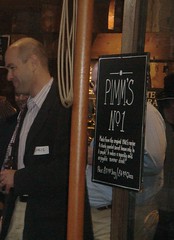
The pub, on Holborn Viaduct, was an interesting experience.

The chat was good – although there were some… unusual personalities at play, met a couple of cool guys who were doing interesting things (business cards from Azeem, Jon, and San), good conversations with Tim and Dan as well, and actually managed to (a) ask a question and (b) follow up with Chris Anderson himself afterwards, which was cool.

More on specific chat shortly. I’ll definitely go back for more dinners if Ian gets more good speakers – Ian and his wife, Sarah, were great hosts and did a good job getting us all corralled (even if it was slighly hard to hear Chris during the talk itself).. . and am sure there were others who contributed to making the evening a success.

Geek dinner

I’m going to my first ever Geek Dinner tonight; it’s with [[Chris Anderson]] of ‘Wired’ fame – he’s got a theory called ‘[[The Long Tail]]’ about how, in and amongst other things, markets and media are evolving from a few mass media, products and services into — thanks to a largely Internet powered world — a mass of niche media, markets etc. There’s a great, and very confusing, quote from Amazon in the Wikipedia article about The Long Tail which might serve to give a practical example of what that means.

I think the Geek Dinners are a great concept, and they seem very popular (at time of writing, there are 72 comments to rsvp, despite the fact that its on a Friday night) — so if anyone has an interest in the topic that’s reading this, please do come along and keep me company. I’ll be the one in the corner who doesn’t know anyone ;).

The importance of being division6

If a lot of the new, cool, social software out there survives, and I eventually get around to using it, I’ll probably want a consistent digital identity – division6… and was pleasantly surprised to find that I could have that username on both Digg and Reddit today. Now I’m thinking I need to go and register for every other service I might possibly use with my digital identity before I lose it to a bot…

Why not use my real identity? Not because I really really love to give fake names, but rather because invariably, after years of forgetting if I’d registered as armand, armand.david, adavid, adavid01, davidfly, ard30, jard30, etc etc, I’d had enough. And division6 is sufficiently obscure that I’ve been able to capture it on most of the systems I need to thus far :).

Like shot from a sling

Arvind’s company officially launched this week, to a chunky piece in the Guardian, amongst others (loads of peeps I know seem to have been in the guardian this week).

I’ve mentioned before that Slingshot Studios is specialising in all-digital film production – and Arvind’s working with some cool folks, on some interesting looking projects (from the little I’ve seen). I imagine more will go up at the Slingshot blog (in due course).

I’ll be speaking to them at some point soon about blogging and movie making — will need to look into quite how successfully people have used blogs to market films of late — but the if the paridigmata that are the King Kong and Superman Returns blogs is anything to go by, I suspect film-goers do want to hear things straight from the movie makers mouths (although those examples are arguably atypical ;)).

England vs Portugal

The referee was a crook, Sven was a fool, Stevie G and Frank L should have taken better penalties, and it was all rather upsetting.

Of course, I may not know what I’m talking about (except for the ‘upsetting’ part) but the long and the short of it is: England’s out.

Enjoyed the match though – shouted head off with a few others around the big screen, and simultaneously read Guardian’s commentary to check how well I was doing at understanding what was going on. The Graun’s coverage was pretty good…

(And I see that Becks has quit as Captain – what will become of the England team under its new stewardship? Who knows?)

I do think I’m going to subscribe to an RSS feed that’ll keep me updated on Spurs progress through the next premiership season, as quite enjoyed the bits of football I’ve watched this World Cup and might be interesting to follow the team I supposedly support… (Of course, Tottenhamhotspur.com doesn’t have any RSS feeds that I can find… grrr).

New York

So, New York was… amazing. Everything from the movies, and TV, that I’ve seen was… true. Moreso. Better. It was like London, stretched – and even more diverse and exciting, if that’s possible.

Don’t get me wrong – I’m not trading cities. The pace of life in NYC was… hectic – more than I’d be prepared to deal with in the long term, I suspect. But it was just… unreal. I was not the only person going around saying “it’s like being in a movie,” — heard at least two passers-by say almost exactly the same words in Times Square. Which is understandable; that’s like Leicester Square on speed.

So, my pivotal NY experiences in a nutshell:

    Having slices of American scale pizza
    Drinking root beer
    Seeing broadway, Madison Square, Statue of Liberty, Ground Zero, the Empire State building, and more
    The walk / don’t walk experience
    Comic book geeks on the street (!!!)
    HOT DOGS. Oh yeah.
    Tipping (man, I hate working it out… much more of a science than here)
    New York cab journeys
    Chinese takeaway, complete with egg roll (so cheap!)
    The NYC retail experience (a world away from the service we get in London – much better!)
    Learning what ‘uptown’ and ‘downtown’ meant
    Central Park in the sunshine, on the water
    Watching movies and photoshoots happening
    Having a bagel near Tiffany’s
    The biggest ever plate of cheese in Mexican restaraunt
    Seeing a broadway musical (oddly, Sweeney Todd, set in London)
    Riding the (so much better than London underground its not funny) Subway

Having problems with my photo plugin for WordPress, so please checkout the photoset if you’re keen to see more…

Relative quiet

The relative quiet is due, in part, to the fact that I seem to have developed hayfever (£$(“$&*!&*$(*!!!!). It’s very annoying and have been feeling pretty rotten for a couple of weeks (thought I had a cold, and may have done for a few days…). Now I’m dosed on on prescription strength anti-allergy gear some sort of normality may resume. But… I have fallen asleep at 8.30pm for the last two nights and not sure how immediately I’ll have the time, energy or inspiration to blog. But hopefully over the weekend…