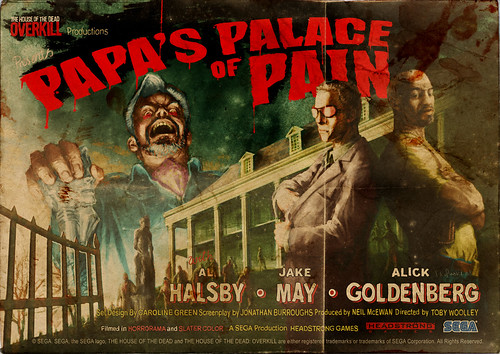
House of the Dead: Overkill and the b-movie tradition

The House of the Dead: OVERKILL - Promotional poster

I used to love light gun games, Time Crisis and its ilk, and in my PS2 days invested a disproportionate amount of money sourcing games and accessories. Ironically, since the games have become more accessible (in the wake of the Wii), I’ve not played any at all. But this weekend, visiting Matt, I was exposed to HoTD: Overkill, a spectacular overdone piece of B-Movie Zombie-killing light-gun action.

There are just a few hours of collaborative gameplay built into it but they’ve milked everything they can from the format pretty effectively, and its a lot of fun.The thing that makes it stand out, though, is the spectacular b-movie scriptwriting. Random plot jumps, totally stereotyped lead characters, disgusting but entertaining plot twists and progressions. Lots of fun.

The dialogue, especially when initiated by Detective Washington, is offensively fun. If you’re of an age and can cope with sweary misogyny interspersed with random introspection, check out a selection of his best quotes here.

Origin stories

Nice poster of Ryan Reynolds as Green Lantern.I’ve been a comic book fan since forever. Most of my friends know this – the Superhero t-shirts, key-chain, icons, etc. are a persistent reminder – so people are always surprised if I haven’t rushed to see Thor, or Green Lantern, or whatever the latest comic book hero movie is.

There is a reason for this, in addition to being a busy dad. As a comic book fan, it takes a very specific kind of comic-book movie to cut through the endless hours of mediocrity that Hollywood churns out on this front. Scalzi has it nailed in a recent Filmcritic.com column:

…it’s not so much super heroes that I’m bored with, than it is origin stories — which is to say, the whole set-up of how said super hero got his powers, how he fumbled a bit with them before he figured them out, how he felt alienated from the world, blah blah blah blah blah, man, I get tired just thinking about them at this point. You know, one of the very salient reasons why Spider-Man 2 and The Dark Knight are considered better than their predecessors is that they didn’t have to spend any time setting up the super hero; they could just focus on the story they wanted to tell. But of course it’s difficult to get to those films without doing the set-up exercises. It’s a catch-22, it is.

Of course, now that there’s a wave of origin stories been told… perhaps we can get to proper movie-making. If there was some really good storytellers with ambition and studios with courage they’d pick up a story mid-flow… Superman Returns, whilst not a perfect piece of film-making, at least had the courage not to completely reboot the series. But then, Superman as a character is significantly better understood than Hal Jordan…

Entrepreneurial will, pt 2

Damian took issue with my perspective on entrepreneurialism as a thing for people with a more aggressive appetite for risk; that is to say, that a gambler (or someone with a ‘gambling personality’) is more likely to have a desire to (if not aptitude) for starting up a business.

His (reasonable) point was that – unless you’re fronting the capital yourself – you’re not gambling with your own money and therefore the ‘gamble’ is damage limited.

I think, however, that this misses a  number of strands of my view on the issue and – at the risk of stretching the metaphor – doesn’t take into account all the characteristics of a gambler. Specifically:

  1. The consequences of failure – reputationally speaking – are sufficiently high that whose capital you are using is largely irrelevant – true for gamblers and for entrepreneurs, although probably moreso for the latter.
  2. The passion required is high for both. You have to have absolute certainty that not only is this what you want to do, but you can make money from it. I have about 60 of poker losses this year; my friend Matt – a much better poker player than I – is about 600 up.  Neither of us are showing great ROI despite our enjoyment for the game.
  3. The commitment required to both is huge. Pro poker players are up all hours on Pokerstars and other online gambling networks, playing multiple tables and trying to grow their capital. I love my job – but I do also love that I can put it down when I go home, most of the time.

So I maintain my view that gamblers make the best entrepreneurs, although happy to be argued with further.

Which Captain Planet ring would you choose?

Mine’s wind or water, as fire and earth are too destructive and heart is too lame. Think of the practical applications!

This conversation was preferable to me than ‘would you rather’ as a way of passing the time on a delayed coach journey the other day.

[polldaddy poll=5223458]

Captain Planet, he drives a Prius, he’s going to reduce emissions down marginally through considered consumerism….

The imaginative landscape of children

Transfomers Optimus Prime (Toys R' Us Exclusive)Watching Em play reminds me of the games I used to play, with my siblings and cousins, when I was growing up. Staring fascinated at the ball, or grabbing for Rigby (the bear) or one of her puzzle toys and waving stuff around with utter, magnificent glee is an absolutely wonderful thing to behold.

My own memories don’t date back quite as far as fascination with balls, but I have distinct memories of creating narratives around matchbox cars and my Transformers collection. The toys would be unearthed from the cupboard and arrayed for magnificent battle, heroic Autobots always triumphant over the evil Decepticons. Overnight stays with my cousin Reyhan would inevitably see us engage in one of these combat scenarios, although Rey – a year older than me – was always magnanimous about letting me be the good guys. I still remember the absolute pleasure I had when I managed to trade an Optimus Prime toy with Rey for some Decepticon toys. I’m sure he got the better deal in absolute value, but I had Optimus. Transform, Mr Prime, and roll-out.

I wonder what games Em will play once she gets past the ‘oooh, shiny’ stage (which arguably I’ve reverted to with my gadget-love).

Booz & co report on Generation C

booznco

My colleague Harriet pointed me to this interesting bit of futurism from Booz & Co, looking at the rise of ‘Generation C’ – a new wave of digital natives born post 1990.

I used to absolutely love this future gazing stuff but I think I’m getting a bit cynical in my old age. As accurately as this seems to anticipate the arrival of certain technologies in the next 5-10 years, it is predictably Western-centric in its anticipation of tech adoption, and worse – it carries a strong weighting to what ABC1 families will be able to afford and educate their children in a way that they will be able or likely to embrace these technologies.

Charlie Stross notes when contemplating near future sci-fi that the future is, to all intents and purposes – 99% now. Some of the things we imagine as fantastical and futuristic today exists in a lab or in the homes of the ultra-wealthy. I remember reading about Bill Gates’ personalised, automated home 15 years ago – and today there still aren’t mass-market home-automation products of that ilk!

This is the fallacy that Booz & Co have fallen into, IMHO. These technologies will be there, but we’re facing an extended period of economic austerity today. That will mean some R&D budgets get cut and some product launches will be delayed. Look at LTE – for the last three years it was coming in 2011/12, and now some people are saying 2013/4. And who will pay the premium?

My fundamental issue is that between infrastructural challenges caused by austerity programmes and corporate conservatism, the growing divide between rich and poor amplified by growing inflation and increased taxation of the middle classes, we may actually see ‘Generation C’ as even more educationally fragmented than the preceding generation. There may be a high level of general tech literacy but as for more sophisticated use? That calls for more exposure, more support, more education. Not things we’re necessarily likely to see in an environment of increasing university fees, pinched spending in schools and high rates of inflation potentially limiting consumer spending on new technologies.

I interview grads every now and then and the most recent lot were born in the late 80s and early 90s. I find them to be as hit and miss as the grads of my generation, and every subsequent generation. Some had the good fortunate to be exposed to tech and embrace it, most people’s digital literacy starts and ends with Facebook.

But as I said, perhaps I’m turning into a cynical old man.

Ill children

I remember being a bit ill quite often as a kid. Well, sometimes actually ill, often of the total hypochondriac school, I was "ill". It probably didn’t help that allergies and intolerances weren’t well understood in that day and in that place, so I spent most of my formative years experiencing discomfort from dust allergies and lactose intolerance (my father used to tell me off for sniffing constantly).

However, I only remember being properly ill a few times. High fevers, properly miserably ill, needing constant brow-mopping, syrup-swallowing care. How did my parents cope?

Em was recently teething and had a couple of days of feverishness, and my panic mode went from 0-60. I started being paranoid about brain damage, wanting to bring the temp down by cooling her brow, wanting to do something. But beyond the occasional calpol dose, it really needed to just run its course, and naturally there was nothing too much to be concerned with (at least insofar as her current bouncy smileyness is something to go by).

Maybe I’ll get used to this, but given that my parents still get paranoid if I have a sniffle or even a lesser malady, I think its something I have for life now. And another bit of insight I have into quite how much my parents care about me, and what it means to be Dad.

Successful entrepreneurs are the best gamblers in Britain

In this week’s Apprentice Helen faced Lord Sugar for the first time, and was exposed to his CV inspecting wrath. He made the point to the successful executive assistant that you don’t just wake up one morning and decide you’re a businessman. You have an idea, you have drive, you have passion, and you do it.

I’ve had a few conversations lately about what it means to have entrepreneurial spirit, in this day and age. Like Lord Sugar, I don’t think being clever, inventive, creative or even organised and hardworking are the core of it. Ultimately, to want to be an entrepreneur, the most valuable personality trait is that of a gambler.

You have to roll the dice.

That’s what it boils down to. Numeracy is important, creativity, a sense of strategy, the market and marketing, leadership skills – all key. But one of the reasons I’ve not started a business myself is the same reason that I rarely push all-in with deuces under the gun, even under punishing blind conditions – I don’t like the stress associated with that level of risk. And indeed, British entrepreneurial culture is far less forgiving of failed gambles in the business realm than other countries (like the US).

So is Britain’s ‘growth agenda’, in no small part founded on the idea that we’ll have a nation of burgeoning entrepreneurs, fundamentally flawed? I’m not sure. It wouldn’t surprise me, though, if the idea of taking a risk on a business proposition is less scary to the average Brit. We seem to have a culture of at least (semi-) calculated risk and we do see a lot of start-ups emerging around the UK.

What do you think?

Armand David's personal weblog: dadhood, technology, running, media, food, stuff and nonsense.